
Table of contents:
TL;DR
Most managers approach FPL Draft thinking it’s about picking the best players. In reality, it’s about managing risk, understanding positional scarcity, and making better decisions over time. On draft day, focus on structure and avoid uncertainty. During the season, stay active — use waivers, follow team news, and adapt faster than your opponents. The edge in Draft doesn’t come from one big move, but from consistently making slightly better decisions every week.
FPL Draft Strategy & Tips for Fantasy Premier League Draft
To talk about strategy and winning in Fantasy Premier League Draft, you first need to understand one thing: this is a completely different format compared to Classic FPL — the version most people are used to.
In Classic FPL, you can take risks. You can make transfers, use a wildcard to fix mistakes, and rebuild your team if things don’t go your way.
Draft doesn’t give you that luxury.
Every player in your league is a unique asset. Once someone picks him, he’s no longer available. And that means you have far fewer chances to fix bad decisions later.
That’s exactly what makes Draft more demanding — and more strategic.
You can’t just react. You have to manage your squad continuously and think a few steps ahead.
Because in Draft, you’re not competing against the game.
You’re competing against the decisions of the same group of managers all season long.
And over time, one thing becomes clear:
- Leagues are not won by having the “best players”
- They’re won by making better decisions — consistently
In this guide, we’ll break down the logic behind those decisions and show you how to apply it in practice to win your FPL Draft league.
If you’re new to the format, you can read our full guide on how FPL Draft works in detail.
Core FPL Draft Strategy: Positional Scarcity, Minutes Projection and Risk Management
Draft usually takes place before the season even begins — and at that point, you simply don’t know which players will perform and which ones will disappoint.
And that’s completely normal.
Your goal on draft day is not to predict the “best players” over the season. It’s to reduce risk and avoid breaking the structure of your squad from the very start. This is where most managers go wrong — they think in terms of “who is better”, instead of asking “what could go wrong”.
One of the first things you start to feel in any draft is positional scarcity.
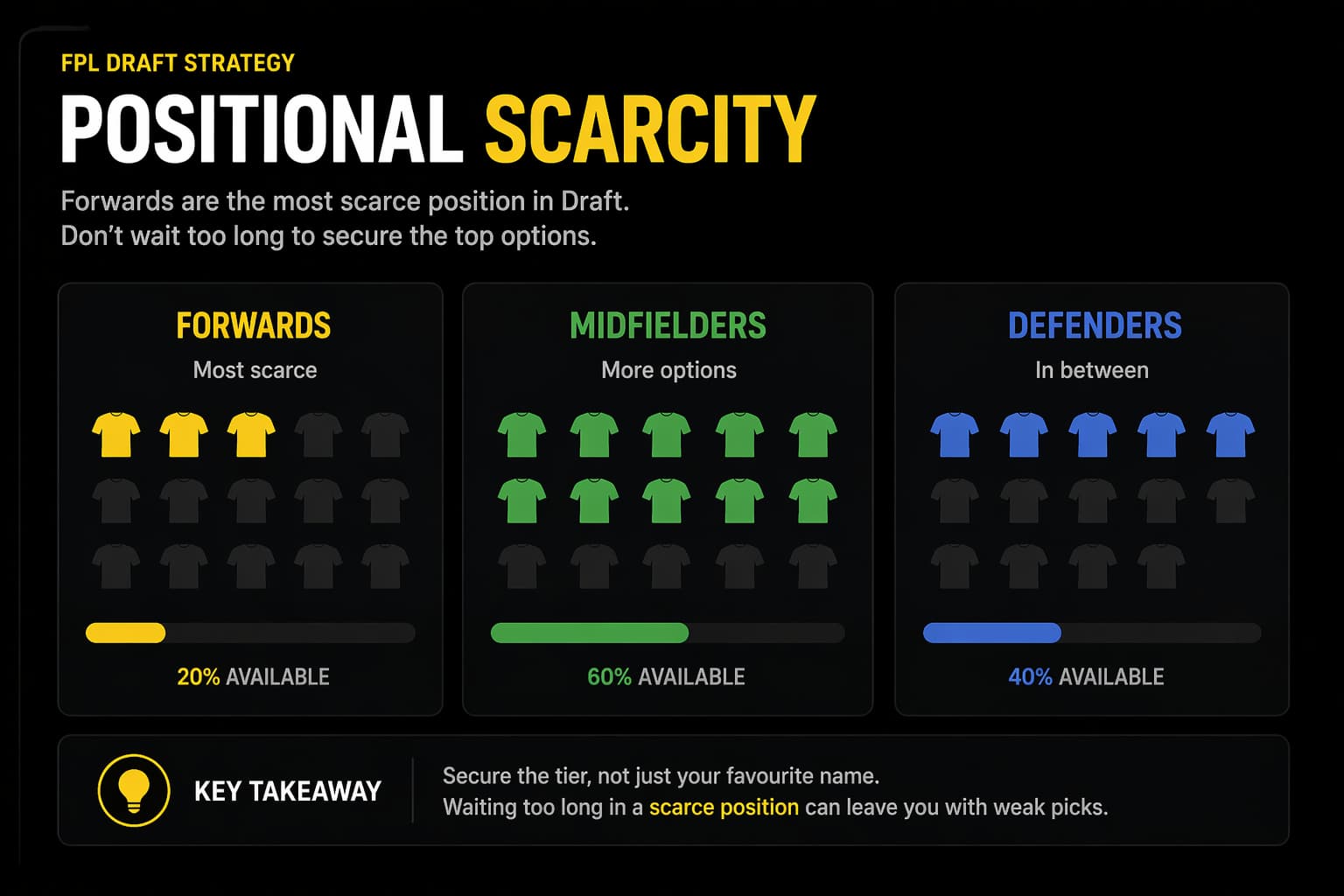
At some point, forwards just disappear. Then attacking midfielders and defenders follow. And if you don’t react in time, you’re left choosing between players who might not even start regularly.
That’s why, on draft day, it’s not enough to evaluate players — you also need to understand which positions are drying up faster than others.
If there are only two or three viable options left in a position, and several picks before your turn, waiting becomes a risk. In those moments, it’s more important to secure the tier than to pick your favourite name.
The second key factor is minutes — not as a fact, but as a projection.
Before the season starts, you don’t know exactly who will play every week. But you can estimate it.
Who looks closer to the starting XI?
Who is less likely to be rotated?
Who already seems like a stable option within their team?
Avoiding obvious risks is often more valuable than chasing upside. Over a full season, unstable players tend to fall behind those who simply play regularly.
This is where preseason becomes a surprisingly useful tool.
It’s not perfect, and you shouldn’t treat it as a guarantee — but it gives you signals.
If you pay attention, you can start to notice patterns:
- players consistently starting in multiple preseason matches
- changes in positioning (for example, a defender playing higher up the pitch)
- teams experimenting with new formations
- players who seem to be falling out of favour
These signals won’t give you certainty, but they provide context — and in Draft, even a bit more context can lead to better decisions.
Of course, watching every preseason match across all Premier League teams is unrealistic.
A more practical approach is to use tools like Sofascore, Flashscore, or similar platforms.
They help you quickly understand:
- team formations
- likely starting lineups
- which players are completing full matches
- who is being used as a substitute
- and who isn’t involved at all
On top of that, preseason analysis from experts can be extremely valuable.
Podcasts, previews, and team breakdowns — especially from people who actually watch these matches — often give insights you won’t get from raw data alone.
They help answer the questions that matter most on draft day:
- who looks like a starter
- how the team is expected to play
- who might get a new role
- who could lose their place or even leave the club
In the end, all of this is about one thing — giving yourself a better starting point.
Because Draft is not about building the strongest team on paper.
It’s about:
- avoiding positional gaps
- reducing uncertainty
- and creating a squad that won’t collapse after the first few Gameweeks
And while the draft rarely wins you the league, it very often loses it.
Fantasy Premier League Draft Tips: How to Approach the Draft Itself
The draft itself feels very different from preparing for it.
Before it starts, you can analyse players, watch preseason games, build shortlists and think through different scenarios. But once the draft begins, everything changes.
The pace picks up. Time becomes limited. And instead of theory, you’re dealing with constant decisions.
This is where most managers make the same mistake.
They try to follow their pre-draft plan — even when the draft itself has already moved in a different direction.
But draft day is not about sticking to a plan. It’s about adapting.
At some point, you start to notice how quickly the player pool changes.
One pick — and your options are already different.
A few more — and the board no longer looks the way it did just moments ago.
And this is where strong managers separate themselves. They don’t just look at their list — they read the draft.
This is also why thinking in tiers works best as a tool, not as a concept.
Because in real draft situations, you’re rarely choosing between a “better” and a “worse” player.
You’re choosing between:
- taking a player now
- or risking that he won’t be there when it comes back to you
And that’s no longer just about player evaluation — it’s about timing.
Very often, the worst decisions feel completely reasonable in the moment.
“I’ll take him later”
“He should still be available”
“I’ll go for someone else now and come back to him next round”
But draft day is not about what should happen. It’s about what is happening right now. And if you underestimate how quickly options disappear, you start falling behind.
Another factor that shapes your decisions is your draft position.
It doesn’t just define your first pick — it sets the rhythm of your entire draft.
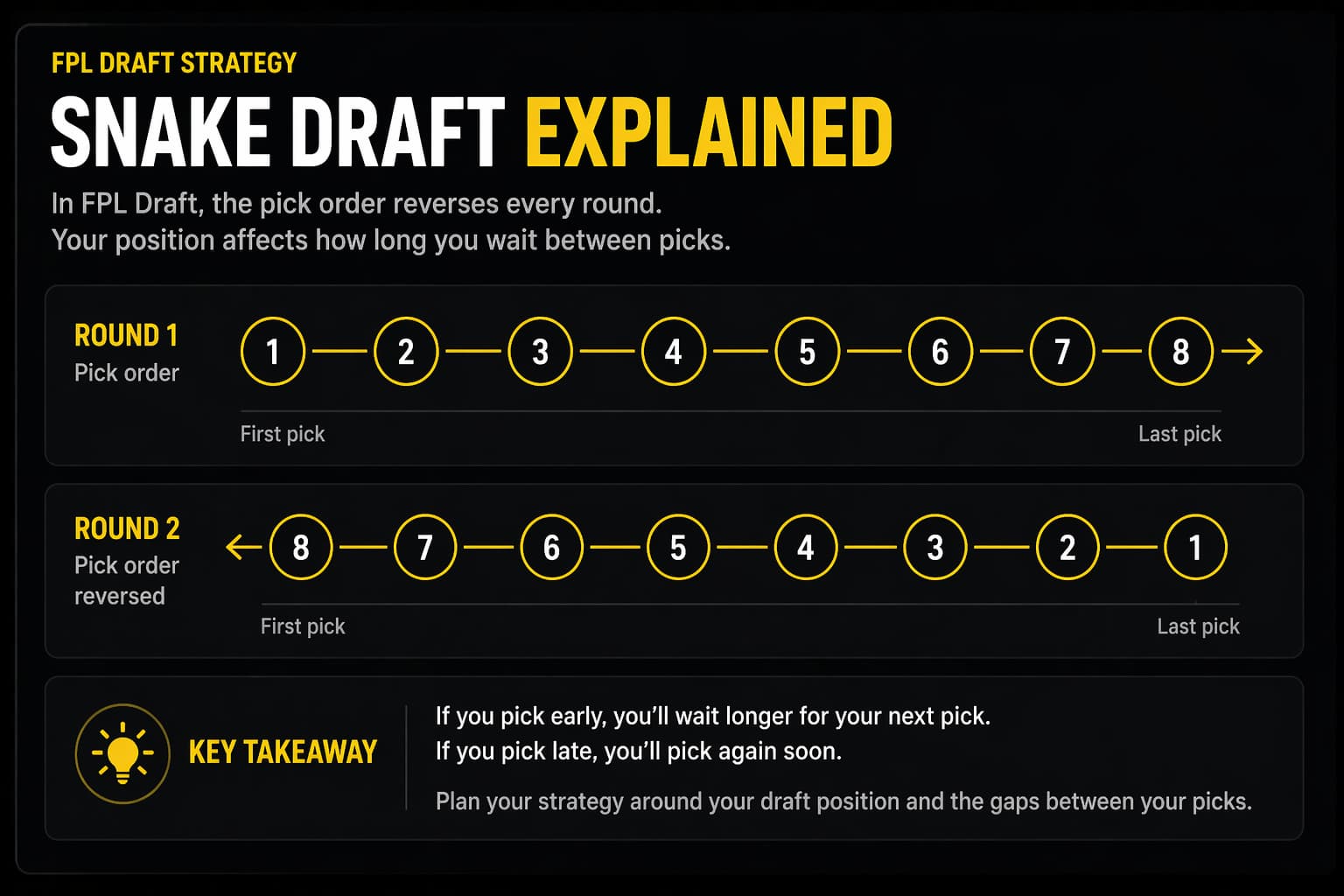
Some managers pick again quickly.
Others wait a long time between selections.
And that changes everything.
If your next pick is far away, taking risks becomes much harder.
If your picks are close together, you have more control.
That’s why your approach should adapt to your draft position, not stay the same throughout.
If you want to understand how to use your draft position properly, read our Snake Draft strategy guide.
One more thing that often gets overlooked is squad structure during the draft itself.
Sometimes the draft presents you with a player who feels like great value — even if you already have that position covered.
In the moment, it feels like the right move.
But a few rounds later, you look at your squad and realise:
- you have too much depth in one position
- and a clear weakness in another
And fixing that later is much harder than avoiding it in the first place.
In the end, draft day is not about perfect picks.
It’s about controlling the situation.
Understanding:
- what’s happening right now
- how the board will change before your next turn
- and how to avoid getting stuck without options
Because in Draft, you rarely lose because of one bad pick. More often, you lose because of a series of decisions that felt “fine” at the time.
FPL Draft Strategy Tips for the Season: Practical Tools and Approach
Once the draft is over, the game changes.
At that point, you’re no longer guessing — you’re working with real information. You can see who actually starts, who gets minutes, which teams look sharp, and which players are genuinely involved.
And this is where most advantages in Draft are built.
Not through one perfect move — but through consistent, informed decisions week after week.
At some point, improving your own team is no longer enough.
The real edge comes from understanding your entire league — how your opponents play, where they are weak, and how matchups evolve.
If you want to see that clearly, you can use a dedicated Draft dashboard. It helps you track standings, analyse matchups, and spot patterns across your league.
To go beyond the current season, learn how to track your FPL Draft league history, including past winners, historical standings, head-to-head records, and manager performance across multiple campaigns.
Try analysing your league with our FPL Draft dashboard with a 14-day free trial.
Watching matches: the simplest way to understand more than the stats
Stats give you numbers. Watching games gives you context.
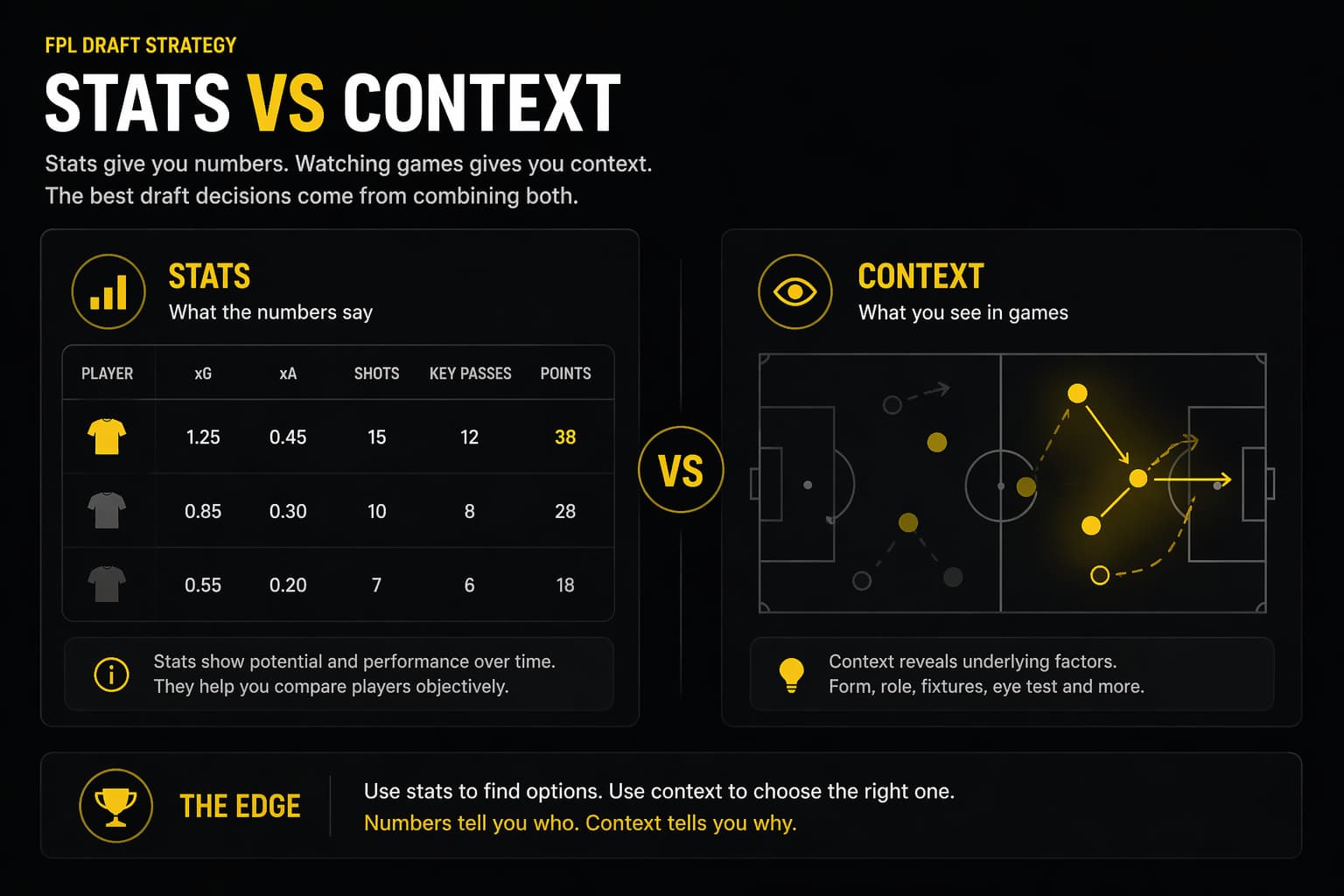
Even watching just one match from a team can tell you things that numbers won’t:
- who actually drives the attack
- where chances are coming from
- which players are constantly involved in dangerous situations
- how the team creates opportunities
You start noticing patterns.
A player might not return in a game, but still be heavily involved in attacking moves — and that’s often a sign that points will come.
Of course, watching every match is unrealistic.
But even catching one game per team from time to time already gives you a real edge.
Stats and expert analysis: how to scale your understanding
If you can’t watch everything — or want to complement what you see — this is where tools and analysis help.
Platforms like Sofascore, Flashscore and others give you a quick overview:
- minutes played
- starting roles
- basic performance data
But the real value often comes from expert analysis.
Podcasts, previews, team breakdowns — especially from people who actually follow preseason and matches closely — can give you insights that raw stats don’t show:
- how a team is really playing
- what the manager is trying to build
- which players are gaining or losing importance
It’s not about copying opinions — it’s about having more context before you make decisions.
If you’re comparing multiple options, using a structured comparison tool can make those decisions much clearer.
Following team news: sometimes this is where the biggest edge is
Availability is one of the most underrated factors in Draft.
Injuries, suspensions, tactical decisions — they all directly affect who plays.
And often, the advantage comes not from knowing more, but from knowing earlier.
Useful sources include:
- official club websites
- team social media accounts
- journalists and reliable insiders
Sometimes small details make a difference.
A player appearing in training photos while still being listed as injured elsewhere can be enough to make a move before anyone else notices.
Predicted lineups: a practical shortcut for decision-making
Another very useful tool is predicted lineups before each Gameweek.
They bring together:
- team news
- press conference hints
- recent form
- expected availability
And give you a quick view of: who is likely to start
This is especially useful for:
- setting your lineup
- short-term pickups
- managing risk
You can also check our predicted lineups page for this
Waivers: where most leagues are actually decided
If we’re being honest — this is where most Draft leagues are won.
Waivers are not just a feature. They are your main tool for improving your team over time.
And this is where many managers struggle.
The most common mistakes:
- holding onto a “favourite” player even when he’s out of form
- waiting too long for an injured player to return
- being afraid to make changes
Stronger managers approach this differently.
They:
- move on quickly from players who aren’t delivering
- react to changes in role and form
- make decisions based on value, not эмоції
And one more important thing: not every player needs to be a long-term pick
Sometimes the right move is short-term.
A player for one Gameweek:
- facing a weak defence
- playing in a good fixture
- benefiting from a temporary role
And it’s completely fine to move on from him right after.
If you want to understand exactly how waivers work and when transactions go through, read our guide:
FPL Draft waivers explained
Key FPL Draft Rules to Remember
If you’re unsure what decision to make — during the draft or during the season — these principles will usually keep you on the right track.
- If a player is not nailed, he’s a risk — no matter his upside
- Don’t compare points — compare roles, minutes, and involvement
- If a position is running out, don’t wait too long — you may not get another chance
- In Draft, losing a tier is often worse than missing a specific player
- Don’t get attached to players — your squad should evolve during the season
- React to changes in role and minutes, not just to last week’s points
FAQ
What is the best FPL Draft strategy for beginners?
Focus on reducing risk rather than chasing upside. Prioritise players with secure minutes, understand positional scarcity, and build a balanced squad. In Draft, stability usually outperforms potential over a full season.
When should I draft forwards in FPL Draft?
You shouldn’t delay too long. Forwards are typically the most scarce position, and once the top options are gone, the drop-off is significant. If you wait too long, you may end up with players who don’t start regularly — and those are difficult to replace later.
How important are waivers in FPL Draft?
Extremely important. Most leagues are not decided on draft day, but through a few key waiver moves during the season. Managers who actively use waivers to react to changes in role, injuries, and form gain a significant advantage.
What is the biggest mistake in FPL Draft?
Passive management. Many managers stop adapting after the draft and rely too much on their initial squad. In Draft, staying active — especially with waivers and squad adjustments — is essential to stay competitive.
How do I choose between similar players?
Don’t rely only on recent points. Compare players based on role, minutes, team context, and long-term consistency. A player with stable minutes and involvement in the attack is usually a better pick than one with short-term form but uncertain role.
Is FPL Draft more skill-based than Classic FPL?
In many ways, yes. Draft rewards long-term decision-making, understanding of squad structure, and awareness of your league. Since you can’t easily replace players, every decision carries more weight.
.jpg)