
Table of contents:
TL;DR
Snake draft isn't about picking the best player — it's about timing your picks and planning ahead.
Your approach should always depend on your draft position. Early picks are about securing a nailed elite attacker and thinking ahead to what won't be available next. Mid picks give you the most flexibility, so the focus shifts to taking the best value rather than forcing positions. Late picks are different — this is where you need to think in pairs and build your team through combinations rather than individual players.
Across all positions, the same principle applies: don't draft for now — draft for your next pick.
Most managers get this wrong. They ignore positional scarcity, overvalue last season's points, or make isolated decisions without thinking ahead.
A strong draft gives you a foundation — but winning your league depends on what you do after.
If you're new to FPL Draft, there’s one thing you need to understand right away:
this is a completely different game compared to classic Fantasy Premier League.
There’s no budget. No template teams. Every player can only belong to one manager. And because of that, your season doesn’t really start in Gameweek 1 — it starts in the draft room.
But just as important is what happens after.
In draft leagues, the real edge often comes from how well you understand your own league — not just your team. Tracking matchups, trends, and decisions over time is what separates active managers from winning ones.
That’s exactly why tools like FPL Centre exist — to give your league structure, history, and insights that go beyond the official game.
What actually happens during the draft
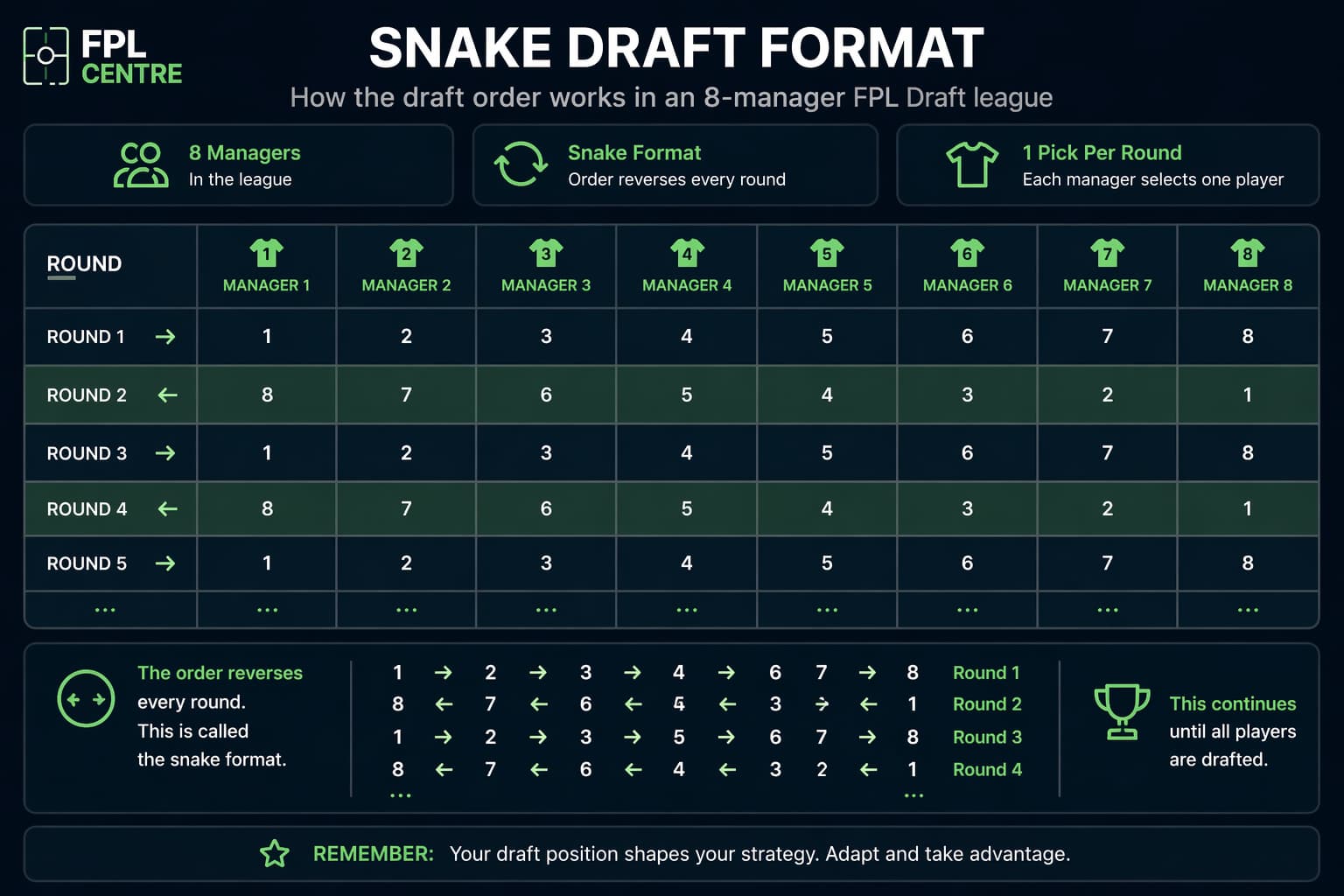
Before the season begins, all managers take turns selecting players to build their squads.
- each manager gets a draft position
- you pick one player per round
- the order reverses every round (snake format)
by the end of the draft, every relevant player is already taken and distributed across teams
And this is the key shift:
you’re not just picking the “best player available”
you’re deciding:
- when to take a player
- whether he’ll still be there at your next pick
- and how he fits into your overall team structure
If you want a full breakdown of how FPL Draft works (rules, scoring, waivers), start here:
FPL Draft explained: rules, scoring and how it works
In this guide, we’ll focus on what actually gives you an edge:
how to use your position in a snake draft to gain an advantage over your league
Because the truth is simple:
most managers don’t lose their draft because of bad players
they lose it because of bad decisions
How snake draft works (and why it matters)
The format itself is simple:
- Round 1: 1 → 8 (or 10)
- Round 2: 8 → 1
- Round 3: 1 → 8
And so on.
But the format alone isn’t the strategy — it just creates it.
early picks wait longer between turns
late picks get two selections in a row
And that changes everything.
If you want to go deeper into overall draft thinking — player evaluation, positional scarcity, decision-making — this guide covers it in detail:
FPL Draft Strategy & Tips
Now let’s break down how to actually play your position.
FPL Draft Strategies: How to Approach Snake Draft Based on Your Pick
At first glance, snake draft looks fair. Everyone gets a turn, the order reverses each round, and no one seems to have a clear advantage.
But in reality, your draft position changes everything.
The biggest mistake managers make is approaching every draft the same way. What works from pick 2 often won’t work from pick 8 — and vice versa.
Because in FPL Draft, you’re not just picking players. You’re managing what happens between your picks.
How long you wait.
What positions disappear first.
Which players won’t make it back to you.
Once you start thinking this way, your strategy naturally changes depending on where you draft.
Early Picks (1–3): Playing Against Time
If you're drafting early, you get access to elite players — but you pay for it with time.
After your first pick, a large chunk of the player pool disappears before it’s your turn again. That gap forces you to think ahead more than anyone else in the league.
The key here is simple: don’t just focus on your current pick — focus on what won’t be available next.
Your first pick should be a nailed elite attacker — either a dominant forward like Erling Haaland or a high-volume midfielder with consistent returns.
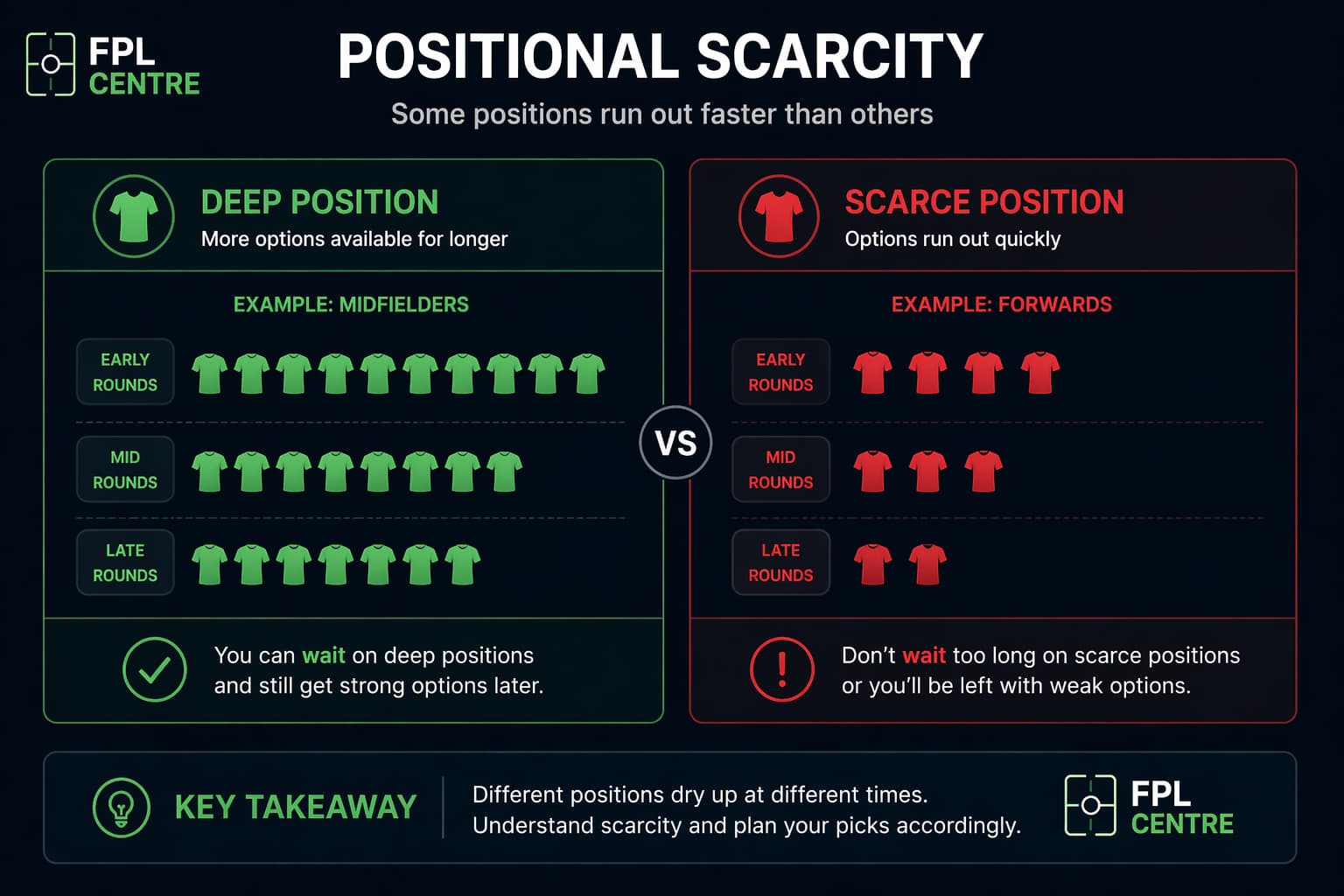
This is where positional scarcity becomes critical. If reliable forwards are running out, you often need to take one earlier than you’d like. Waiting usually means settling later.
Your first pick should always be a stable, high-minute player with a clear role. That’s your foundation. After that, your job is to protect your team from future gaps.
Managers who get this right don’t necessarily draft the “best-looking” team — they draft the most complete one.
Mid Picks (4–6): Control the Value
If you're drafting in the middle, you’re in the most balanced position in the draft. You don’t have long gaps between picks, and you’re not forced into early decisions, which gives you something very valuable — control.
Your goal here is simple: take the best value available, not the position you planned.
In most drafts, one position starts going earlier than expected — usually forwards. When that happens, strong midfielders or even top defenders often drop lower than they should. That’s where your advantage is. Instead of following the same trend as everyone else, you take what falls to you.
In the first round, you simply pick the best player available without forcing a position. In rounds two and three, you start shaping your team structure, ideally combining positions — for example, midfielder + forward or forward + midfielder. This keeps your squad balanced without overcommitting too early.
The biggest mistake from mid picks is trying to play like an early pick — forcing decisions or locking into a rigid plan before the draft even starts. The strength of this position is flexibility. The better you read the draft, the stronger your team becomes.
Managers who get this right don’t try to predict the draft — they react to it and consistently take value others leave behind.
Late Picks (7–10): Win the Draft in Pairs
If you’re drafting late, it might feel like you’ve missed out on the very top players. In reality, you gain something even more powerful — control over two picks in a row.
Your strategy should always be to think in pairs, not individual players.
Instead of focusing on a single “best player available,” you should be thinking about combinations. What two players can you take together that give your team the strongest possible start?
The most effective approach is to build your core immediately. This often means pairing a forward with a midfielder for balance, taking two players from the same tier to control value, or combining a high-upside pick with a more reliable one. The key is that your picks work together, not separately.
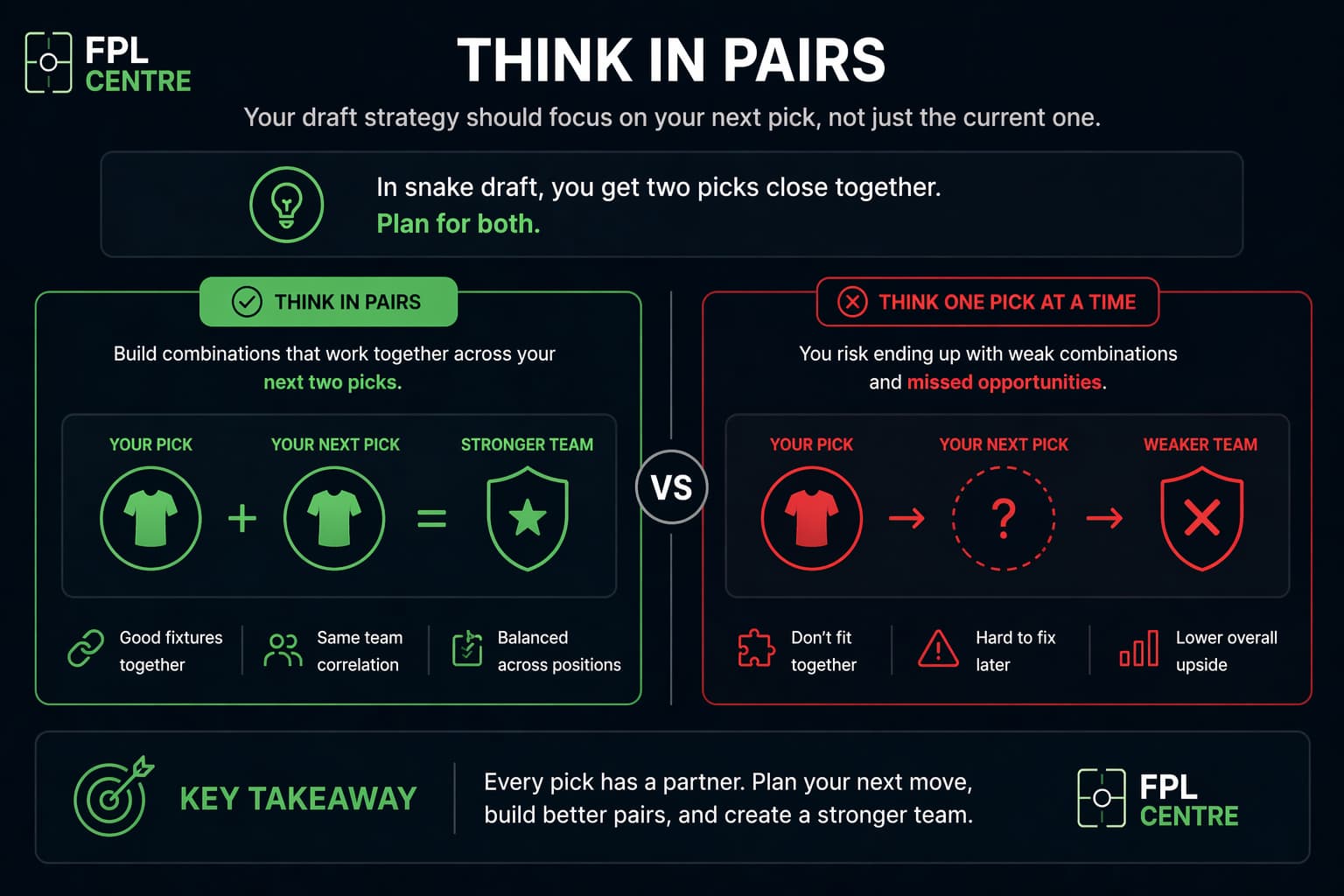
For example, instead of making two disconnected decisions, you create a structure right away — something like Watkins + Saka or Isak + Bruno. That immediately gives your team direction and balance.
After your first turn, your focus shifts to filling the gaps. You look at what your team is missing — whether that’s a second forward, midfield depth, or more stability — and build from there.
The biggest mistake late-pick managers make is treating each pick in isolation or chasing only the “best player” without context. In reality, late picks don’t win by getting the best individual option — they win by building the strongest combinations early and putting pressure on the rest of the draft.
Which Draft Position Is Best in FPL Draft?
At some point, every manager asks the same question: is it better to pick early or late?
The honest answer is that there’s no perfect position. Each draft spot gives you a different kind of advantage, and the outcome depends on how well you adapt your strategy.
Early picks give you access to elite players, but you lose control between turns. Late picks give you back-to-back selections and more control, but you miss out on the very top names. Mid picks sit in the middle, offering the most balance and flexibility.
Your goal isn’t to get the “best” pick. It’s to understand what your position allows you to do — and play into that strength.
Managers who try to play the same way from every position usually struggle. Those who adjust their approach based on where they draft tend to build stronger, more complete teams.
Common FPL Draft Mistakes
Even experienced managers make the same mistakes during the draft, and most of them come down to one thing — ignoring context.
The most common mistake is focusing only on the current pick. Drafting isn’t just about choosing a good player, it’s about understanding what will happen before your next turn. If you don’t think ahead, you’ll constantly miss key players by one or two picks.
Another major issue is ignoring positional scarcity. Waiting too long on certain positions, especially forwards, often leaves you with options that are difficult to rely on over the season.
Many managers also rely too heavily on last season’s points. Without context — minutes, role, team changes — those numbers can be misleading and lead to poor decisions.
There’s also a tendency to take unnecessary risks early in the draft. Trying to be clever or different too soon often creates problems that are hard to fix later. In most cases, a stable and structured start gives you a much stronger foundation.
Avoiding these mistakes won’t guarantee a perfect draft, but it will immediately put you ahead of most managers in your league.
FPL Draft Day Checklist
During the draft, decisions happen quickly, and it’s easy to lose track of the bigger picture. Having a simple framework can help you stay consistent.
Before each pick, take a moment to think about what happens next. Will this player still be available when it comes back to you? If the answer is no, you probably need to act now.
It’s also important to consider positional pressure. If a certain position is starting to disappear, waiting can leave you with significantly weaker options.
At the same time, every pick should fit into your overall team structure. You’re not building a list of players — you’re building a team that needs balance.
Finally, pay attention to tiers. If there’s a clear drop in quality after a certain player, that decision becomes much more important.
The more consistently you apply these checks, the easier your decisions become.
Draft Is Just the Start
A strong draft gives you an advantage, but it doesn’t win you the league on its own.
Over the course of the season, things change quickly — injuries, rotations, form, and fixtures all impact player value. Managers who stay active and adapt will always outperform those who rely only on their draft.
A big part of that comes down to understanding how transfers work during the season. If you’re not using waivers and free agents correctly, you’re leaving a lot of value on the table. If you want to understand this properly, read:
FPL Draft Waivers Explained
Think of the draft as your starting point. The better your foundation, the easier it is to build on it.
But the real edge comes from what you do after.
Make Better Draft Decisions
If you want to make more confident decisions during your draft, using the right tools can make a big difference.
With the Compare FPL Players tool
you can quickly compare players side by side and get a clearer picture of their role, minutes, and underlying output.
While draft decisions are made before the new season starts, last season’s data still gives you valuable context — especially when comparing players with similar profiles.
It helps you move beyond gut feeling and make more structured decisions, even when the clock is ticking.
The better your information, the better your decisions — especially when every pick matters.
FAQ
What is the best draft position in FPL Draft?
There is no single best position. Early picks give you access to elite players, late picks give you more control with back-to-back selections, and mid picks offer the most balance. The key is adjusting your strategy based on your position.
Should you draft a forward or midfielder first in FPL Draft?
In most drafts, you should prioritise a nailed elite attacker. This can be a top forward or a high-volume midfielder, depending on availability. The decision often depends on positional scarcity and what is likely to be taken before your next pick.
How important is draft position in FPL Draft?
Draft position is very important because it affects how long you wait between picks and which players are likely to be available. Different positions require different strategies to build a balanced team.
What is snake draft in FPL Draft?
Snake draft is a format where the order of picks reverses each round. For example, if Round 1 goes from 1 to 8, Round 2 goes from 8 back to 1. This is designed to keep the draft balanced.
What is the biggest mistake in FPL Draft?
The most common mistake is focusing only on the current pick without thinking ahead. Successful managers plan for their next pick, understand positional scarcity, and build their team with structure in mind.
Should you draft players from the same team?
You can, but it should be done carefully. Taking two players from the same team can increase upside, but it also increases risk if that team performs poorly. It’s usually best to limit this approach and focus on overall balance.
How do you win your FPL Draft league?
Winning doesn’t come only from the draft. A strong draft gives you a good start, but consistent decisions during the season — especially waivers and transfers — are just as important.
.jpg)